This text describes the acaricidal mode of action of oxalic acid. We also make some remarks on the safety of oxalic acid sublimation.
Oxalic acid in nature
Oxalic acid is a natural defence component of plants and is often found in nature. It is produced in the leaves or roots of plants to prevent insects and mammals from eating them. Depending on the organism, it is anorexic, toxic and food deterrent. Its ability to act as a natural weapon for plants, which generally do not want to be eaten, should not reassure us. On the contrary it is an indication of toxicity. On the other hand, the “banality” of oxalic acid means that both we and bees have developed some defense mechanisms. The use of oxalic acid is ideal for organic beekeeping provided it is not used simultaneously with the collection of honey and other products for sale.
Pharmacological profile
Oxalic acid has a relatively fast acaricidal effect and can be classified in the broad category of contact active substances. It is a lipophobic and non-volatile substance. Therefore it cannot easily penetrate the exoskeleton of the arthropods. It works as an acaricide because the bees are less sensitive to it than the mites. In particular, Oxalic Acid has a small relative difference in toxicity between bees and mites. This can be speculated based on the available toxicological data. In 2006, a study calculated the mortality from direct contact with the substance in 24 hours [1]. We got the median lethal dose (LD50) divided by the mass of each arthropod and we came across these interesting figures [2]:

Based on this derived data, we have to exclude any possible targeted action of Oxalic acid (e.g. in neurons). This non-selectivity is probably the reason why no varroa strains resistant to oxalic acid have been detected so far. Despite the widespread use, no selective pressure is applied. Table also shows the relative tolerance of arthropods to oxalic acid compared to amitraz, the widely used substance.
The common fallacy with oxalic acid is that it is treated as having “targeted action” and rare side effects (i.e. as a pure synthetic acaricide). It should not be forgotten that oxalic acid is a very simple substance. Because of its moderate toxicity to varroa, large quantities of O.A. must be used so that there will be a notable acaricidal effect. That is why under hive conditions, many of the varroa are expected to recover from the toxic shock.
Pharmacotechnics of O.A.
Oxalic acid is a lipophobic, non-volatile molecule and thus it cannot be dispersed within the colony in a satisfactory manner. Its pharmacology, therefore, depends on its carrier substance or on means of dispersion. The ways in which oxalic acid may come into contact with the varroa mite are the following:
- Layer of crystals. The layer is formed on the bees by the sublimation method or by spraying a mist of an aqueous solution of Oxalic acid. The varroa absorbs the oxalic acid either by touching the crystals with its body, or by stepping on them with its feet.
- Hygroscopic substance (glycerin, or syrup/OA dribble). The hygroscopic substance sticks to the exoskeleton and accelerates the absorption of oxalic acid.
- In water droplets (spraying or fogging).
- Through food. Systemic uptake by parasitizing the bees.
The physicochemical behavior of the oxalic acid that is dispersed in the cell environment changes depending on the absolute/relative humidity and the possible existence of water droplets. However, these changes are of minor importance, as the average colony keeps its environment stable (homeostasis). When oxalic acid is carried by a hygroscopic substance (eg glycerin) the differences are much greater [3].
Action mechanism
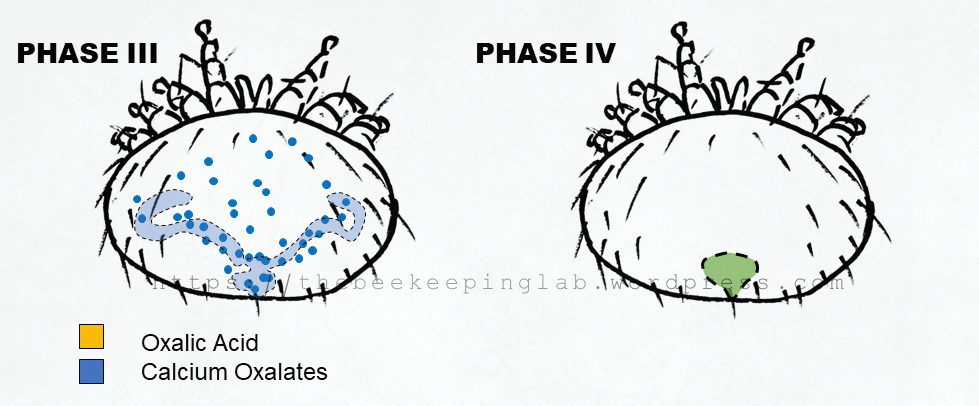
The mode of action of Oxalic acid has not been sufficiently investigated. It likely acts by disturbing the pH in the arthropod’s hemolymph and then binds with calcium to form calcium oxalate crystals, which are deposited in its tissues. The process takes place in the hemolymph after the oxalic acid passes into the hemocoel [4]. Oxalic acid probably follows the following pharmacological path in the body of the mite:
- Some oxalic acid molecules penetrate the varroa exoskeleton. The acid molecules pass into the hemocoel and into the hemolymph (absorption). They are distributed according to the tissue/cell barriers (distribution) [5] .
- The high acidity produced in the hemolymph disturbs the homeostasis of the mite. Enzymes, cell membranes, mitochondria, etc. do not function as they supposed to be, as their environment becomes deregulated. A fluid imbalance may follow.
- Oxalic acid binds calcium molecules forming calcium oxalates which are crystalline solids, also toxic to the mite [6]. These crystals may be deposited in adjacent tissues.
- The mite becomes non-functional, falls off the bees and eventually dies. If it survives, the mite’s body manages the toxic shock and compensates for the homeostatic damage.
- The survived mite gradually manages the calcium oxalate crystals it accumulates in its digestive tract. The removal of toxic substances from the hemocoel probably follows the usual excretory pathway (Malphigian tubules, etc. [7]). However, there is conflicting evidence regarding crystal deposition [8]. Perhaps there is too little organic calcium within the mite to form large deposits.
- The products of oxalate metabolism remain in the lower digestive tract of varroa until they are excreted within a cell during the next reproductive cycle.

The difference in oxalic acid toxicity between the honey bee and varroa (see above) can be attributed to their physiology as well as their size. The bee’s exoskeleton is much thicker than the varroa’s exoskeleton which reduces the absorption of oxalic acid. The size/surface ratio between varroa and bee is also very different, so the bee is less exposed per mass unit compared to varroa.
This mechanism presupposes that their exoskeleton is to some extent permeable. Oxalic acid is either absorbed directly, or through multiple “weak points” such as tracheas, pores, glands, synapses, joints, etc. There is also the alternative hypothesis of the weak point (“Achilles heel”) which will be examined next. One does not exclude the existence of the other.
Other mechanism of action suggestions
“Achilles heel“: In this version, the absorption of oxalate by the exoskeleton is minimal, because it is protected by the chitin layers. Oxalic acid ends up in the hemolymph from the legs of the mite [9]. The subsequent course of O.A. is similar to that described above.

This, I believe, would have caused a larger “gap” in toxicity between varroa and bees, something that should have been observed empirically. We may simply be dealing with a slightly different mechanism of action in O.A. sublimation compared to the methods with glycerin, syrup/dribble etc.
Chemical burn: Varroa’s legs have special suction cups to cling to surfaces. It has been suggested that this system is damaged by the acid and so the varroa cannot attach itself and/or feed properly. The case is combined with the above, but can also stand independently. There is another related report [10] that O.A. damages varroa mouthparts and makes the mite unable to feed (I have not found more evidence).
Intersystemic intake: According to this older hypothesis, the bee takes in the oxalate, raises levels of the acid in the hemolymph, and then the varroa takes up the oxalate through parasitism. Since we now know that varroa does extraoral digestion it is rather difficult to be particularly harmed by the whole process [11]. Any considerations to use oxalic acid systemically should be rejected. The oral toxicity of oxalic acid to bees is four times that of contact toxicity. The 72-hour LD 10 is 60.03 µg and 256.4 µg per bee respectively [12].
Sterlilization: Another speculation for which we have no evidence. The evidence we have is that reproductive cycles are disrupted as a result of oxalic acid toxicity. This does not necessarily mean that the O.A. caused infertility.
The Long-term exposure of varroa to oxalic acid is almost unexplored. There is probably toxicity at sub-lethal doses that we could take advantage. These properties may be exploited with the 1:1 O.A./glycerin by weight recipe on sponges (Randy Oliver’s recipe). Classic O.A./ glycerin tapes do not offer such possibilities. An example of long-term toxicity is that it can damage the exoskeleton by destroying its proteolytic barrier (as it also potentially does on the exoskeleton of bees [13]).
Sublimation of O.A. and the Beekeeper
As previously written, the “banality” of oxalic acid in nature and in our own metabolism means that we have developed some defense mechanisms. The problem is that these mechanisms are in our digestive [14], urinary and endocrine systems and not in the respiratory system. Therein lies the potential long-term danger to O.A. sublimator operators. Three things are of concern to us regarding respiratory exposure to oxalic acid:
- The immediate, destabilizing effects of inhaled oxalate and formic acid on the mucosa and epithelial cells.
- The formation of calcium oxalate microcrystals in tissues.
- Damage from the body’s immune response. Because the body reacts and tries to block any foreign body.
Clinical data for all of this obviously do not exist, because the application of oxalate in this form concerns only beekeepers. The fact that there is an immune response during the inhalation of the sublimation mist is easy to establish, even with zero clinical data. The coughing from inadvertent inhalation of the gases is evidence of an immune response. The immune system tends to form coatings around any foreign bodies (crystalline acid or calcium oxalate in this case). These coatings are not always absorbed and some of them may become foci of future pathogenesis.
The studies we have on calcium oxalate crystals in the lungs are some cases of patients with an aspergillosis infection, a fungus that produces calcium oxalate (Aspergillus Fumigatus, Aspergillus Niger) [15], [16]. The micro-crystals remain in the tissues causing micro-injuries and inflammation. Apparently in healthy people the crystals are removed (probably with the help of special proteins), which is not the case in people with the fungus. It is indicative, however, that these patients have serious complications from the “oxalosis” itself when the fungus subsides (with treatment).
In the absence of empirical data, therefore, the appropriate approach is prevention. Prevention means proper masking, gloves, washing clothes and minimizing work inside the sublimator fog. The beekeeper should not rush the sublimations and should be several steps away from the sublimator while working (moving to the side and against the wind). Smooth sublimation at lower temperatures appears to be safer for the operator, in the sense that it enables quick withdrawal from the vapors. High temperature sublimators, on the other hand, disperse more of the oxalic acid vapors in the near by environment and therefore the operator is working in a cloud (albeit a much thinner one). These concerns are expressed from a safety perspective (not acaricidal results).
If all this seems excessive to someone, we point out that safety in the work environment is based on the logic of optimal risk minimization. On the contrary, the traditional Greek approach is to “weigh” the risk and, after “knowing” it, to play with it. Moreover, the strange phenomena of the “unfortunate moment” can be found topologically in Greece, where accidents and disasters have their own particular theory of causation.
George Mitsikas (chemist, amateur beekeeper)
Alexandra Kalamida (drug & cosmetics technician)
December 2022
** It is not allowed to republish the article (reblogging, etc.), or to reproduce it (total/partial) without the permission of the editors.**
REFERENCES – COMMENTS
- [1] Aliano, NP, Ellis, MD, & Siegfried, BD (2006). Acute contact toxicity of oxalic acid to Varroa destructor (Acari: Varroidae) and their Apis mellifera (Hymenoptera: Apidae) hosts in laboratory bioassays. Journal of economic Entomology, 99(5), 1579-1582.
- [2] The numbers listed for Amitraz are indicative of the relatively low O.A. mite toxicity. Results vary from one study to another, the method of measurement, times, durability, etc. They are summarized in the paper: Bahreini, R., Nasr, M., Docherty, C. et al. Evaluation of potential miticide toxicity to Varroa destructor and honey bees, Apis mellifera, under laboratory conditions. Sci Rep 10, 21529 (2020). https://doi.org/10.1038/s41598-020-78561-2
- [3] Milani, N. (2001). Activity of oxalic and citric acids on the mite Varroa destructor in laboratory assays. Apidologie, 32(2), 127-138.
- [4] The hemolymph/hemocoel system is difficult to understand without basic entomology knowledge. The video typically shows the movement of hemolymph inside the insect (Syrphidae fly) :
- [5] Oxalate quickly passes into the hemolymph and is distributed to other tissues in a few hours in a study done on bees. The same happens with varroa due to commonalities in their physiology. See also: Determination of oxalic acid and other organic acids in honey and in some anatomical structures of bees María Jesús Nozal, José Luis Bernal, Luis Antonio Gómez, Mariano Higes, Aranzazu Meana Apidologie 34 (2) 181-188 (2003) DOI: 10.1051/apido :2003001
- [6] It is not determined where the binding of calcium can take place (e.g. calcium channel) Calcium oxalate is also toxic but has no acaricidal effect. We assume that it must be in the varroa’s tissues, in order to became toxic.
- [7] Oxalic acid is distributed in the Malpighian tubules (again in the study by Nozal et al.)
- [8] No accumulated crystalline calcium oxalate was found in the malpighian tubes when realistic doses of O.A. where applied in bees. Ivana Papežíková, Miroslava Palíková, Silvie Kremserová, Anna Zachová, Hana Peterová, Vladimír Babák & Stanislav Navrátil (2017) Effect of oxalic acid on the mite Varroa destructor and its host the honey bee Apis mellifera, Journal of Apicultural Research, 56:4, 400-408, DOI: 10.1080/00218839.2017.1327937
- [9] This information came from an O.A. sublimator seller. Published data could not be found.
- [10] Al Toufailia, H., Scandian, L., & Ratnieks, FL (2015). Towards integrated control of varroa: 2) comparing application methods and doses of oxalic acid on the mortality of phoretic Varroa destructor mites and their honey bee hosts. Journal of Apicultural Research, 54(2), 108-120.
- [11] Varroa feeds extraorally on the fluid that has come from the hemolymph and adipose tissue. Her gastric system is expected to have good resistance to acids.
- [12] Rademacher, E., Harz, M., & Schneider, S. (2017). Effects of oxalic acid on Apis mellifera (Hymenoptera: Apidae). Insects, 8(3), 84.
- [13] Strachecka, A., Paleolog, J., Olszewski, K., & Borsuk, G. (2012). Influence of amitraz and oxalic acid on the cuticle proteolytic system of Apis mellifera L. workers. Insects, 3(3), 821-832.
- [14] Oxalic acid is not innocent even in our digestive system. A healthy person can immediately see the unpleasant side effects of oxalates, if they completely remove dietary sources of calcium from their diet and eat foods high in oxalates (almonds, dark chocolate, spinach, etc.). It should be noted that honey does not belong to these food categories, even when oxalic acid is used continuously.
- [15] Cho, GJ, Ju, JY, Park, KH, Choi, YD, Kim, KS, Kim, YI, … & Yoon, W. (2003). Pulmonary Oxalosis Caused by Aspergillus Niger Infection. Tuberculosis and Respiratory Diseases , 55 (5), 516-521.
- [16] Nakagawa, Y., Shimazu, K., Ebihara, M., & Nakagawa, K. (1999). Aspergillus niger pneumonia with fatal pulmonary oxalosis. Journal of Infection and Chemotherapy, 5 (2), 97-100.
 The Beekeeping Lab
Leave a comment