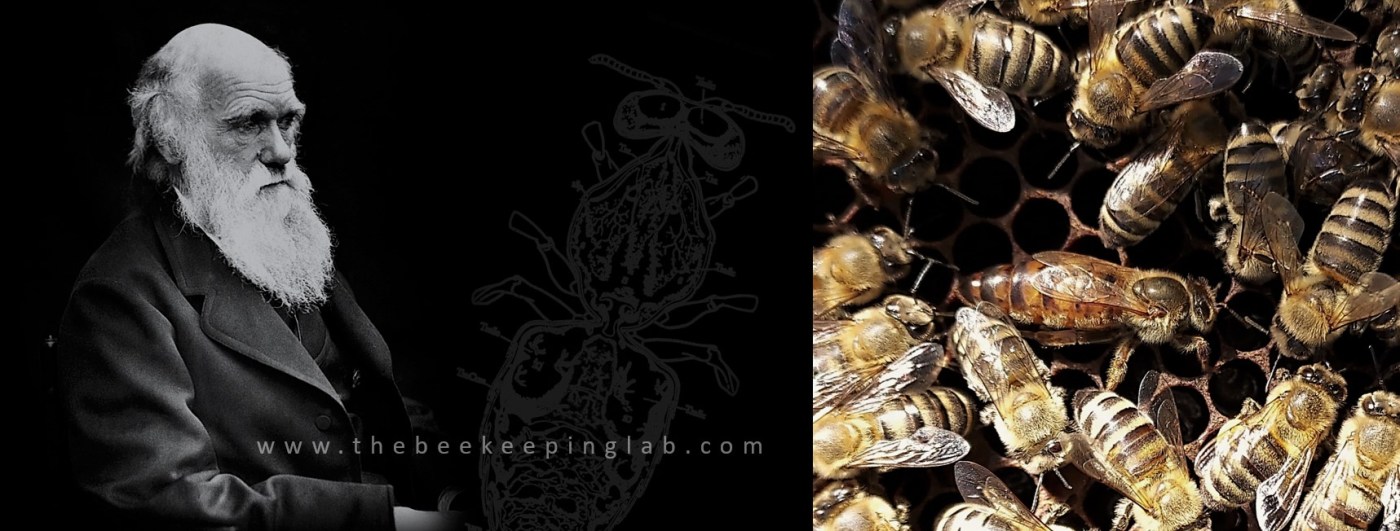
In recent years, some forms of alternative beekeeping have been revitalized, such as treatment free, biodynamic and “natural” beekeeping. These practices exploded in popularity when world-renowned Professor Tom Seeley publicized his experiments in 2017 and introduced the name “Darwinian Beekeeping”. Seeley’s argues that the concept of evolution through natural selection is rarely used in beekeeping. By imitating the physical condition of bees and natural selection, we can lead them to overcome their problems. Solutions will emerge fast if we are as attuned with Darwin as we are with Langstroth 1.
In the past, the field of “natural” beekeeping was inspired by a new age philosophy like “the bees overcome everything with the power of nature”. Along the way, interventions by Seeley and other scientists appropriated the alternative forms of beekeeping, involving the principles of evolutionary biology. In this text, I will explain how this combination of alternative beekeeping and science has produced a pseudo-Darwinian culture of extreme practices. My main problem with the so-called “Darwinian Beekeeping” is that it is not Darwinian enough. And, I don’t mean it is not hardline enough as he should be, but quite the opposite. It constantly uses the appeal to nature, forming a particularly appealing rhetoric to organic and amateur beekeepers.

The Burrow of Naturalness
Many, therefore, attempt “natural” and treatment-free beekeeping based on Darwinian arguments. I will develop them below, without limiting the commentary to Seeley’s proposals. Besides, Seeley is quite careful in his wording and instructions, but he is easily distorted and used for more hardline methods. In the abyss of “naturalness”, any natural beekeeping method will never be natural enough. A more “natural” and “pure” way will always emerge.
First Claim: “Bees have survived millions of years facing diseases and pests without human intervention. So it has, or can develop, the mechanisms to deal with varroa etc. as long as we let nature do its job.”
This is a logical fallacy since we can say the same about every species currently living on earth, even those that are about to become extinct. Everything has survived. In natural history, countless well-adapted species have been lost. The varroa destructor was able to exterminate the European bee species if humans had not intervened. Natural forces are not guarantor forces.
Second Claim: Nature has the method of natural selection to reject misfits and choose the good ones. Natural beekeeping is closer to natural selection.
Natural selection is a process of exclusion over thousands of years. It is paradoxical to claim that natural beekeeping can simulate it. What they are doing is a kind of artificial selection, just in another direction than the conventional. In fact, natural methods often exert overwhelming selection pressure, exposing bees to chronic stress (parasitic and dietary). Also, the survivors of natural selection are not always the most resilient, even in the face of the factor that almost annihilated them (called the survivorship bias²). The evolution of species involves three other mechanisms besides natural selection. We find no references to them because they are so circumstantial that they spoil any plausible narrative ³.
Third Claim: Any intervention or assistance with chemical, biological or even natural substances delays the natural adaptation of the bee against pathogens and parasites.
Another fundamental mistake around which treatment free beekeeping is built. We find it in its entirety in Seeley’s text. On the contrary, the intervention gives the bees time to adapt. How much time credit had the first A.M. colonies when they come into contact with varroa? Very little and they were lost. The argument is also wrong from an empirical, everyday point of view. It is like saying that humans can’t be resistant to a disease as long as they take medication for it.
Fourth Claim: Through natural beekeeping methods, the Varroa mite loses its aggressive nature and develops symbiotic relationship with bees.
Varroa Destructor is a European honey bee parasite. It is unlikely to lose this character soon, just because some people placed bees inside tree trunks and they let them swarm every year. Remember that parasites have remained the same for millions of years and do not easily change in mutualistic relationships. For example, parasitic wasps, these beneficial ancestors of bees, remained parasites. However, in the current evolutionary context, we never know what will emerge. During the era of angiosperms, some parasitic wasps abandoned parasitism and became herbivores, only for the first bees to emerge later!
Fifth Claim: Bees in nature choose their new queens, while we with our techniques prevent them from choosing them.
One of the weakest claims in Seeley’s text. A meticulous look at swarming reveals that there is an egalitarian randomness in natural queen rearing. It is as if workers “choose not to choose” their queens, making abundant queen cups that will be laid by the queen in a random manner. Workers simply then discard some improperly fed larvae, while retaining the random element. Surprisigly, many of the queen grafting techniques retain an analogous element of randomness.
Darwin’s Interpretations
Classical Darwinism examines natural selection retrospectively. It describes what has happened, not what is going to happen. However, precisely because natural selection appears like a law of the universe, it can be falsely twisted to futurology. Modern evolutionary theory has even less to do with determinism and predictability. In the twentieth century it was radicalized through the work of paleontologists Stephen Jay Gould and Niles Eldridge. Although there is not always consensus in evolutionary biology, it appears that that randomness, circumstance, and spontaneous self-organization of organic matter (cybernetics) are the drivers of the evolution of organisms. For Gould and Eldridge there is no such thing as the gradual evolution of species described in classical Darwinism. Evolution has explosions, inertias, ups and downs.

In addition, “Darwinian” beekeeping is also inspired by teleology. Teleology is based on Aristotle’s system of thought and predicts that everything in nature plays a role, or fulfills a purpose. “Telos” in ancient Greek means “purpose”. Popular sayings like “nature does not leave things to chance”, “the economy of nature”, “the great circle of life”, are teleological. Teleology was not only refuted by evolutionary biology, but also by philosophy (Descartes, Spinoza, Kant, Hegel, etc.). In the 20th century however, teleology has been reinvented in its naturalistic form. Moreover, it remains a basic and utilitarian way of thinking of ordinary people, political systems, and even scientists. The “Aristotelian” observer hastens to retroactively attribute “meaning”, “wisdom” and “purpose” to this overwhelming abundance of organisms we call “nature”. Only the teleological mind assumes that the honey bees, after they overcome the great disturbances caused by humans, will be able return to their former “holistic” state. In Darwinism (modern or classical) there is no such thing. The “acceleration of natural selection” advocated by pseudo-Darwinism will be easier to produce a new species than to correct the existing one.
Successes or Exceptions?
Several regions around the world do not treat for varroa, and this has encouraged the treatment-free endeavors. A closer look at each case, of course, reveals the particularities of these resilient bees, as well as the unintentional and circumstantial way in which they arose. They are topological and hereditary peculiarities that do not allow the parasite populations to grow so much as to cause problems. But these hundreds of wonderful exceptions seem to exist just to confirm a frustrating rule: that we cannot do professional beekeeping without treatments! In Greece, due to overcrowding and high migration, the treatment free effords fail quickly.

Time Credit
How can we use Darwinian evolution to our advantage? The good news is that the same natural principles apply to all colonies, whether they are in a sophisticated “natural” hive or in the “unnatural” Langstroth. The basic thing the bees need is time! This is achieved by treatments and techniques that keep for low populations of varroa for many years, and under-manifested viral loads. On the contrary, hypernomadic beekeeping and crowding in the areas of sought-after honeys constantly introduce new strains of pathogens, taking away adaptation time. Subject to time credit, the available arsenal is not small. For example, the following characteristics work against the varroa/viral complex:
- Simple genetic defects among populations that pose a problem for varroa growth. This has already been noted in bees that have ecdysone disorders ⁵.
- Ex-aptation, i.e. when bees readjust an older function for a new enemy. Exaptation is the fastest way to develop partial resistance ⁶.
- Immunological, or biochemical type of resistance. It works well against simple life forms (ex. bacteria, fungus) and against chemical compounds ⁷ (plant toxins). Unfortunately it does not affect in complex organisms such as mites. Nevertheless, immune resistance is key in the fight against viruses.
Organic therapies seem to be the most long-term and viable solution to any threat, with one drawback, which has not yet been solved. They have greater toxicity than conventional ones and often cause major disruptions of homeostasis, indirectly deregulating the bees immune and behavioral defenses⁸.
In the enemy camp
Stephen Jay Gould was right when he said that the dominant form of life on earth is bacteria, apparently not humans. The prism of epizootology should also be used in beekeeping. Both varroa and viruses currently are in their aggressive and highly pathogenic phase. For both there is low genetic diversity and so very few genotypes predominate. According to a virology study⁹, Large and long-term varroa loads exert great evolutionary pressure favoring the pathogenic srains. Dense apiaries full of sick beehives summon the 4 horsemen of the Darwinian apocalypse ¹⁰.

If some people think that Armageddon strikes only the professional apiaries and excludes the holistic ones, they are fooled. High migration of beehives in an area makes it easier for a pathogen or parasite to go from enzootic to epizootic and potentially panzootic. But “Natural” overexposure practices and extinction processes may do just as harm. A key prerequisite for “Darwinian beekeeping” to work, according to Seeley, is to regularly monitor varroa levels and remove problematic beehives from the experiment. I would be surprised to learn that followers of such practices adhere to it.
At some evolutionary point, genetic diversity is expected to increase again and the highly pathogenic strains will perish. A key in this direction may be to maintain more drones throughout the year alongside low parasitic loads ¹¹. We are talking in a realistic short-term context of a few decades, not about “developing symbiotic relationship” between varroa and bees. One may note the similarities of the above points with some of Seeley’s individual points. The key difference, however, is that Darwinism for Seeley lies always outside conventional beekeeping. The implicit difference is that evolutionary biology is not deterministic or teleological. The investment package “evolution by natural selection” comes without guarantees. Past yields do not guarantee future ones.
“Darwinian” Ethics
Finally, the game of constant appealing to nature has a moralistic dimension. What is certain is that by constantly mentioning “what is natural” you stand out from the crowd of the “unnatural”. The teleological moralization of beekeeping, has a dark underside behind respect for bee/nature. At the same time that treatment free beekeepers cite the good health and well-being of bees, they are prepared to tolerate crushing swarm losses of more than 80%, as well as their chronic suffering, until their supposed resistance springs up. All in the name of natural selection, the “good” and “bad” genes. Let us understand the broad implications of this rhetoric and how they undermine sustainable and practical solutions in beekeeping.
George Mitsikas
June 2023
*It is not allowed to copy and/or republish this article or part of it, without permission from the author*
NOTES
- Seeley, T.. (2017). Darwinian beekeeping: An evolutionary approach to apiculture. American Bee Journal. 157. 277-282. The article is republished here.
- The survivor’s fallacy is analogous to genetic drift.
- The other three unpopular mechanisms are genetic drift, genetic mutation and gene flow.
- From a meme of sketching science. The ape on the left image appears as the ancestor of man (however Darwin mentioned the common ancestor). Humans did not decent from apes, humans are apes.
- More here
- A more tangible example is varroa’s resistance to targeted acaricides.
- Behaviors such as weeding developed for acarapis, braula and pollen mites can become a defense against varroa.
- They may also affect symbiotic factors.
- High varroa loads and vector transmission of viruses reinforce the phenomenon of “evolutionary bottleneck” for viruses. Woodford L, Evans DJ. Deformed wing virus: using reverse genetics to tackle unanswered questions about the most important viral pathogen of honey bees. FEMS Microbiol Rev. 2021 Aug 17;45(4):fuaa070. doi: 10.1093/femsre/fuaa070. PMID: 33320949.
- Let’s remember an earlier analogy by Randy Oliver. For Oliver the four horsemen are: Poor diet, Weather instability, Toxins and Parasitic Stress. But the analogy Conquest- War- Famine- Death also fits from a pest/pathogen point of view.
- With simple methods such as having one drone comb per beehive for 3-4 months a year. Freeze the 1st time and reduce the load of varroa. Then let the rest grow on the drones. Drones act like a “buffer”.
- Woven hives Image from pixabay
 The Beekeeping Lab
Leave a comment