To what extent can a beekeeper influence the so-called genetic material of their bees? In free mating, only few things can be controlled in each generation of queens (due to polyandry, etc.). However, it is believed that with persistence, long-term improvement of honey bees can be achieved. Organized breeding centers know well that there is not enough control in this way and try to further restrict the gambling of nature. They resort to special techniques (artificial insemination, mating control, laboratory monitoring, etc.). Despite that absence of control, empirical observations show something different: bee phenotypes are very easily affected (frequently for the worse). For example, bad weather or a bad diet during queen rearing can “ruin” the entire batch of produced queens.
Which of these three scenarios is true? Are honeybees truly plastic, or can they only be influenced through sophisticated methods? The text answers these questions by examining the main genetic mechanisms behind bee breeding.
The expression of genes
In order for an organism to be formed from its genes (phenotype), countless biological steps are followed. Genetic information is divided into active and inactive and then the active information is translated into precursor substances. Multicellular organisms control their ontogenetic processes through cellular differentiation. In the female bee, genes function in pairs, known as alleles (Latinized term from the Greek “άλλος”= the other). One part comes from the father and the other part comes from the mother. There are dominant and recessive allele genes. One allele can dominate the other, but there can be co-dominance, incomplete dominance, and other variations. For example, the genes that encode the color of the thorax in the open-mated A. Mellifera Scutellata are eight1. Even simple things like colors make up a puzzle that only geneticists can solve.

Despite the complexity, there are empirical selection methods that, when focused on 1-2 characteristics of the colony, produce results. When selective breeding is further narrowed down, relative consistency is achieved. However, multiple homozygosities in desired genes do not exclude the possibility that the same may occur in undesired genes. Thus, when certain characteristics are overemphasized, others are also exaggerated, leading to consistent levels of heterogeneity over time. The constant pursuit of homogeneity ultimately creates heterogeneity2. It should be noted that a behavioral trait is never a matter of a single allele pair, but is due to dozens (if not hundreds) of genes. The situation only simplifies in the case of hybridization, where hybrids with relatively predictable behavior are produced. We will see why below. Common statements like “the gene responsible for swarming” or “the gene responsible for hygienic behavior” are misunderstandings.
Epigenetics, not Genetics
Since genetics are so complex, why do the conditions of queen rearing have such a direct impact on the phenotype of the queen? The answer is that most of the visible outcomes of queen rearing are not related to genetic changes. What has such an immediate effect on queen rearing is epigenetics, the way genetic information is expressed. Genes “lock” and “unlock.” They are controlled, expressed, and repaired by epigenetic factors. The honeybee is a testament to the wonders of epigenetics. From a single egg, depending on how it is raised, it can develop into completely different individuals. Four possible phenotypes from the same set of genes:
- Worker (incomplete female)
- Queen
- Intermediate queen (intermorph)
- Diploid drone (abnormal).
The explanation is simple. The composition of the royal jelly given to the larva determines the differentiation of its cells. The composition of the jelly contains substances that act as primers and is highly variable depending on breeding conditions, bee genotype, etc. These substances determine the course of cellular differentiation, in which each cell acquires a role and identity. Thus, the composition and duration of exposure to the royal jelly produce different phenotypes. The process of silencing unnecessary DNA segments occurs through chemical methylation.

In the case of the diploid drone, we have an epigenetic anomaly. It occurs with higher frequency when there is inbreeding. The epigenetics of Apis Mellifera thus confers a plasticity to the phenotype. Precisely this plasticity creates the illusion to the beekeeper that they can easily control the “genetic material”. This can also be empirically confirmed. Otherwise, well-organized queen breeders would not resort to their elaborate methods.
Epigenetic changes have a slight cumulative tendency from generation to generation. As indicated by a related study⁴, the epigenome is also inherited by the descendants of the queens. The difference is that it is reversible. I believe this translates to the fact that, for example, many of the effects of poor queen breeding are not determinant. They can be reversed after a few generations of quality queen breeding. Acquired and transmissible characteristics include the microbiome, as well as an immunological mechanism (transgenerational immune priming).

Selection and evolutionary pressure
Organisms undergo genetic changes over time. The honey bee (Apis Mellifera), as it no longer lives in a natural environment, is influenced by three main factors:
- The natural laws of biology (natural selection, genetic drift, gene flow, and gene mutation).
- Human selection, which is purposeful.
- The evolutionary pressures imposed by beekeeping practices without the beekeepers themselves realizing it.
In the latter case, climate and microclimate changes are also impactful. Selection, regardless the cause, is divided into positive and negative. When the non adapted colonies perish, we have negative selection. Positive selection means that a characteristic provides a competitive advantage to a colony, resulting in greater reproductive success within its own kind. What is certain is that in order to accelerate behavioral characteristics through selection, genetic diversity is sacrificed. Selecting from 1% of the beehives in the apiary each year is a sure path to degeneration. This phenomenon has been identified for a long time⁵.
In Greece, since the development of modern beekeeping and onwards, there have been evolutionary changes in the local honeybees. There should not be an impression that after the introduction of foreign breeds, everything has become a “soup” with heterogeneous characteristics, etc⁶.
Hybridization
Hybridization is, we would say, the diametric opposite of inbreeding. In hybridization between unrelated races, we have a huge number of heterozygotes. Genetic diversity skyrockets, resulting in an explosion of certain characteristics (hybrid vigor). The outcome is indeed predictable, due to the numerous heterozygotes. That is why the first honeybee geneticists experimented extensively with hybrids. The issue with hybridization is that things get confused in the immediate next generation.

Polyandry
Polyandry is a characteristic of Apis Mellifera and is not found in bee species like bumblebees⁸. The term, which is Latinized Greek means “a female having lots of men” (“polys”= a lot and “andras”= man). Polyandry is a subject of extensive study, and in short, it provides a significant evolutionary advantage to bee colonies. The colony gains a diverse pool of generically different workers to maintain homogeneity and adapt to environmental challenges.
Polyandry is the natural counterbalance to overexpressed characteristics. That means that when a stock has genetic diversity combined with polyandry, the colonies display homogenous behavior. On the contrary, multiple homozygous genes, a small number of mated drones, results in extensive heterogeneity among colonies of a stock. The poor performance of a queen bee is often mislabeled as “poor genetics”, when most likely is a problem of poor mating.
It seems that nature has another peculiar mechanism as if polyandry was not perplex enough. It is the transposition of DNA segments from one parent chromosome to the other (DNA recombination). This phenomenon occurs at a high frequency in the honeybee. Yet another piece of evidence that genetic diversity is critical. Polyandry is so underestimated that it is even considered an “issue” like, “how do I know that the 15 drones mating with my queens won’t be the genetically inferior ones from neighboring apiaries?” The problem is actually negligible. Most drones raised poorly cannot compete with the prime ones in the high-speed mating flights.
Selective Breeding in Greece
In Greece, there is heterogeneity in beekeeping practices. We have local breeds, imported queens, and significant nomadism, even the traditional Chalkidiki method of reproduction through uncontrolled swarming. We have a bit of everything. However, the local bees have clearly evolved towards specific directions. We are not dealing with a “genetic soup” in the context of queen imports and polyandry. It’s just that the optimal adaptations have not occurred. As mentioned before, there are strong evolutionary pressures that act consistently and despite our intentions. These have led to at least three observable adaptations:
- Bees have adapted to the strain of frequent inspections and transportation. Other races and species of productive bees have lower tolerance for such things.
- A second adaptation is hygienic behavior, which now exists in almost all honeybee colonies9. Hygienic behavior is not exactly an adaptation, but an exaptation. This means that a characteristic that nature intended for a specific function is being used for a completely different function (ex. cleaning out Varroa infections or chalkbrood instead of cleaning out chilled brood).
- A third adaptation is the resistance and faster metabolism of chemicals (e.g., acaricides, solvents) as well as organic acids (oxalic acid). Bees that do not tolerate treatments, combined with infestation by Varroa, gradually drop out of the game.
All these adaptations are related to varroa and intensive beekeeping (nomadic)10. For each of these, honeybees paid a fitness cost. They lost something to gain something else. In our country, it is considered that the entire apiary should be multiplied from few donor colonies (the “best” ones). Recent discoveries about varroa mites, polyandry, etc. are not easily accepted.
Determining the Future
I believe that the peak of bee performance in advanced beekeeping countries was achieved somewhere between 1970 and 1980. After Varroa and onwards, the genetic pool decreased 11,12. Subsequent adaptations came with their respective fitness costs and there is now a “ceiling” to productivity. Any improvement on a mass scale will come from increasing diversity within locality. Each ecotype should be preserved while simultaneously increasing its diversity. For those who insist on propagating from natural swarm cells, intentional forced swarming can be adopted (in a section of the apiary). This method does not exert selection pressure towards swarming. On the contrary, letting the bees on “autopilot” systematically favors colonies that easily construct swarm cells.
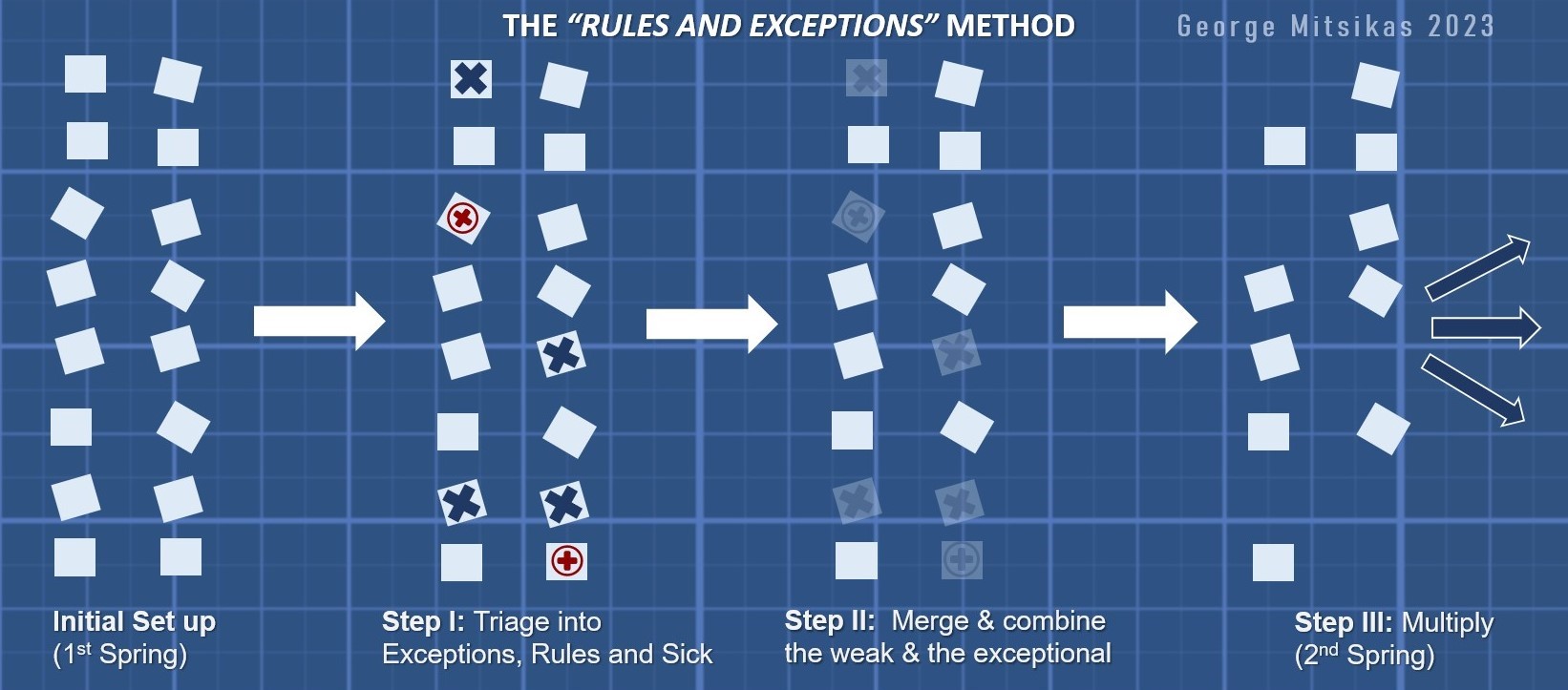
New data will shape selection and screening systems that will reproduce from the majority of the colonies and will not exert evolutionary pressures. The craft of breeding should place more emphasis on epigenetic factors rather than genetic ones. Thus, the evaluation of colonies can be freed from the burden of diligently measuring characteristics. This is done very simply by separating the stock into “rules” and “exceptions.” The conventional way of selection seeks to find the good exception and multiplies it. On the contrary, we want the multiplication of the rule and from as large a number of bee colonies-“rules” as possible.
George Mitsikas (chemist, amateur beekeeper)
January 2023
*Reblogging, or reproducing (in whole or in part) the article without the authors’ permission is not allowed.*
REFERENCES
- Patterson Rosa L, Eimanifar A, Kimes AG, Brooks SA, Ellis JD (2021) Attack of the dark clones the genetics of reproductive and color traits of South African honey bees (Apis mellifera spp.). PLOS ONE 16(12): e0260833. https://doi.org/10.1371/journal.pone.0260833
- This can be mitigated by intersecting separate and independent topological lines that have been selected for the same feature.
- Intermorph queens can be recognized by the rear legs (their basitarsus).
- Yi, Y., He, X. J., Barron, A. B., Liu, Y. B., Wang, Z. L., Yan, W. Y., & Zeng, Z. J. (2020). Transgenerational accumulation of methylome changes discovered in commercially reared honey bee (Apis mellifera) queens. Insect Biochemistry and Molecular Biology, 127, 103476.
- In a 1952 scientific literature text, we find examples that are “as if a day hasn’t passed”: Otto Mackensen, William C. Roberts (1952) Breeding Bees
- Genetic variation is different from hybridization between unrelated breeds. The way this is expressed phenotypically is something else.
- Genes responsible for dark abdomen pigmentation are dominant. Due to chromosome flipping, recombination and dominant genes, we cannot tell by color what race genes they carry. These bees do not display hybrid vigor properties.
- All five honey bee species are polyandrous. Apis Dorsata is the most polyandrous among them.
- The hygienic behavior is a different characteristic from the varroa sensitive hygiene (VSH), which is a specialized skill. Unfortunately, many breeders sell regular queens as specialized ones.
- Beekeepers tend to prefer “generalizers” over “specializers” and that creates adaptability problems.
- Espregueira Themudo, G., Rey-Iglesia, A., Robles Tascón, L. et al. Declining genetic diversity of European honeybees along the twentieth century. Sci Rep 10, 10520 (2020). https://doi.org/10.1038/s41598-020-67370-2
- There have been studies that found the opposite, but the sample size was small and the bees were possibly hybridized. Harpur, B. A., Minaei, S., Kent, C. F., & Zayed, A. (2012). Management increases genetic diversity of honey bees via admixture. Molecular Ecology, 21(18), 4414-4421.
- Original Article in Greek. New images were added in the English version.
 The Beekeeping Lab
Leave a comment