At the end of autumn, brood production in honey bee colonies shows a declining trend until it ceases entirely. The colonies during this period may appear to be inactive, but in reality, a mechanism that is critical for winter survival is triggered. This mechanism is called diapause. Diapause is defined as the suspension of the queen’s egg-laying in response to adverse environmental conditions, which may be periodic or incidental. This suspension occurs once or twice each year in certain climates. This article will explore the role that diapause plays within the colony, the factors that signal its beginning, as well as the relevant beekeeping management practices.
The onset and duration of diapause depend on climatic and seasonal factors. We observe this variability in the highly diverse climate of Greece. In mainland Greece, colonies exhibit a short diapause in summer under drought conditions and a longer one beginning in late October. In Greece’s dry-thermic zone, the colonies display the opposite pattern: the main diapause occurs in summer, while the shorter one takes place in autumn. This two-diapause annual pattern disappears in more northern and mountainous regions, where colonies undergo only a single diapause event.

Fig 1: Diagram of brood in relation to population in the region of mainland Greece.
Whatever the climate-defined pattern may be, the onset of diapause always precedes the onset of winter.
Advantages of Diapause
Beekeepers may take advantage of diapause to carry out varroa treatments and to assist the colonies in overwintering. Furthermore, diapause allows the queens of the apiary to rest, while it puts brood viruses into full recession (although the asymptomatic viral load remains).
In intensive beekeeping, diapause periods are generally shorter compared to non-intensive and stationary beekeeping. Within a nomadic logic, there is the practice of constantly chasing the blooming and the mild weather. In these colonies, the frequency of brood diseases is higher, and they require a greater number of varroa treatments per year. Indeed, it is not uncommon that diapause is mistakenly considered a period of inactivity and wasted time. Conclusively, the diapause onset and duration can be significantly affected by beekeeping practices.
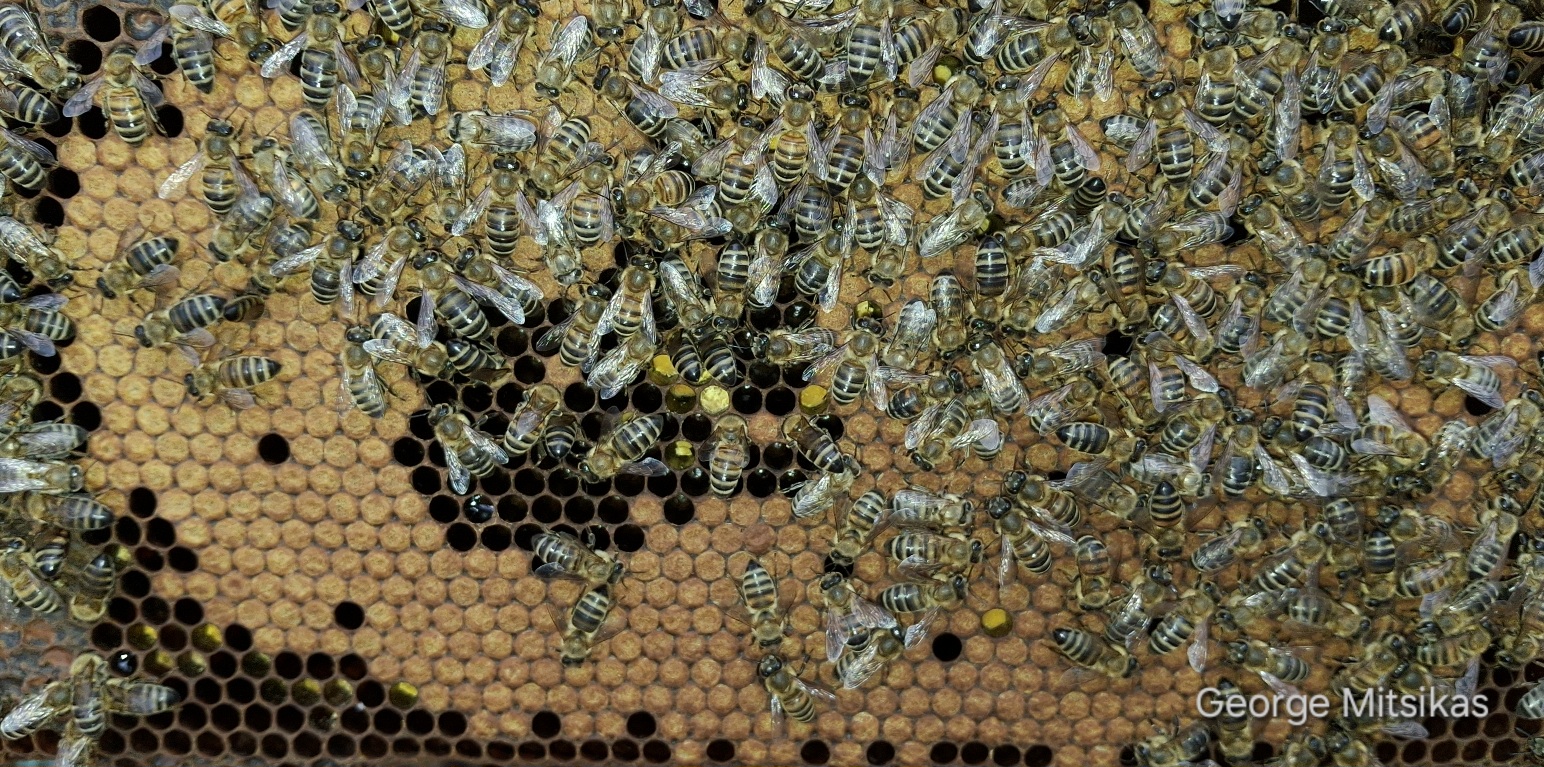
Pic 2: The colony enters diapause and has its last extensive sealed brood of autumn (9 November). Eggs and young larvae are minimal. The bees that will emerge will not rear brood and will be long-lived.
The Role of Diapause
When brood rearing shuts down in a honey bee colony, a series of biological changes is triggered [1]. The cessation of brood rearing alters the physiology of the younger bees in the hive (newly emerged bees, nurse bees, and house bees). As these bees are no longer engaged with the production of royal jelly, their develop a larger fat body. The hypertrophic fat body, which is a difussed organ, promotes longevity and functions as the colony’s main energy and protein reserve during overwintering.
The long lifespan of winter bees is linked not only to the fat body but also to the absence of brood pheromones. In social insects, pheromones are extremely powerful hormone-like signals. Even the pheromone of open brood alone accelerates worker aging [2], turning them into bees with a 45-day lifespan. Although fat body hypertrophy begins in the generations of workers well before diapause, diapause ultimately creates a sufficient subpopulation of winter bees, which in Greek ecotypes numbers about 10,000 individuals. This subpopulation forms the bridge that carries the colony into spring.
As autumn nights become colder, the workers are clustering more frequently. The winter cluster is not large enough to cover and maintain a stable temperature over extensive brood areas. By entering diapause, the colony is relieved of the demanding task of brood heating.
Until recently, it was believed that the winter cluster was a «sophisticated survival mechanism» that allowed the colony to endure cold seasons without difficulty. In contrast, maintaining the cluster under cold conditions is a stressful state that requires high energy expenditure [3]. The cluster structure is rather an emergent property. Although clustering behavior is important, it is the workers’ individual physiology (fat body, fluid homeostasis) that allows them to cope with thermal demands, hypothermia, stress, and have longer lifespan. This is why colonies that may be large but have not properly renewed their population with winter bees are easily lost in February or March. Finally, diapause appears to rest the queen from continuous egg-laying, allowing a strong restart later.
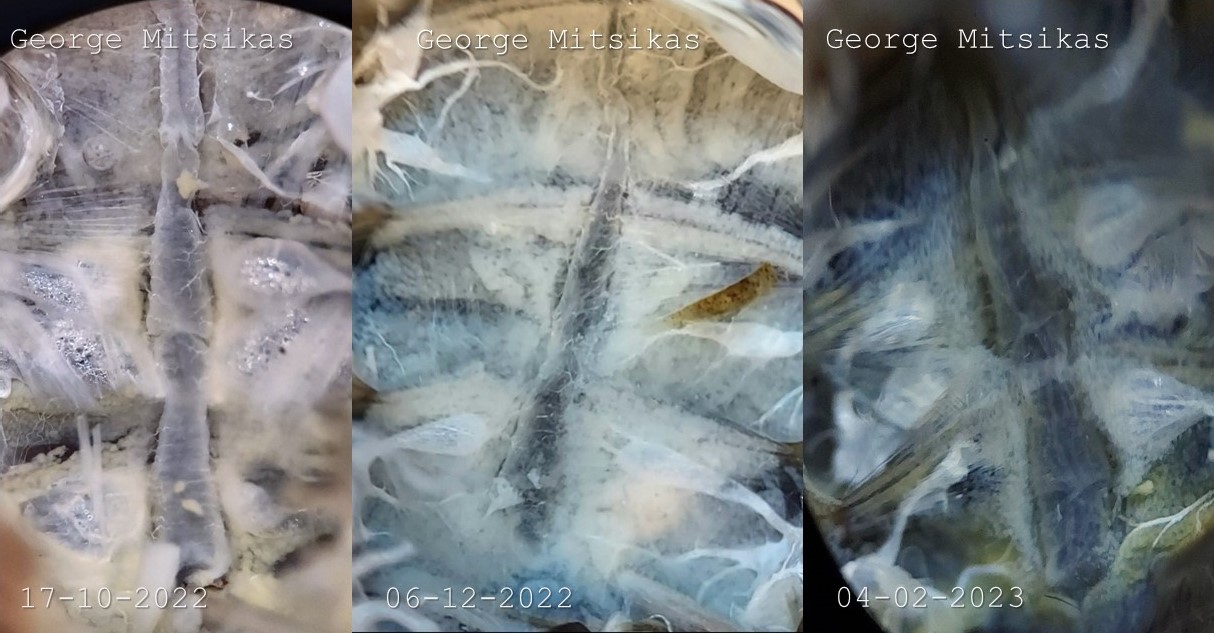
Fig 3: Fat bodies surrounding the aorta and heart. The fat body consists of thousands of nodules (small lumps). The nodules in an overwintered worker bee (right) are much fewer. Bees with fat bodies are not distinguishable to the naked eye (even though one might expect them to look “fatter” than others). The reason bees “expand” in size is mechanical—for example, when they fill their crop (honey stomach), when they are holding feces, etc.
It is important to clarify that diapause is essentially «programmed» to occur. The colony does not choose it consciously, nor do bees enter diapause because they are wise or because they foresee winter. The idea that bees have a purpose or that they are coordinated by an agent (e.g., the queen, collective intelligence) leads to the anthropomorphic fallacy, a common error with roots in antiquity [4]. The fact is that biological functions and animal behaviors are counterintuitive and therefore cannot be articulated using concepts from human societies.
Types of Diapause
The diapause is not unique to the Western honey bee, as many arthropods undergo it. It is common that physiological processes are synchronized with periodic environmental changes (light, temperature, etc.), creating bio rhythms. It is also hypothesized that Apis mellifera queens possess a circannual rhythm—an internal biological clock that determines egg-laying cycles [5].
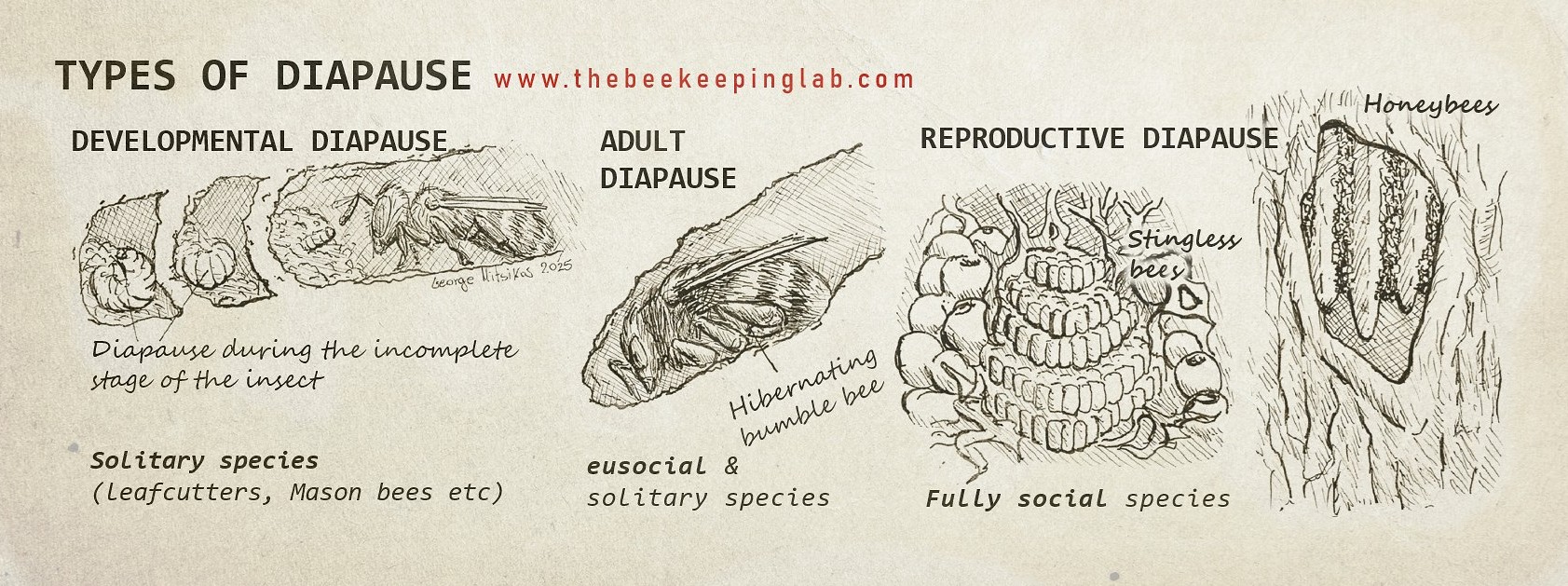
The discipline of entomology provides useful insight into the types of diapause [6]. Among the seven bee families, the following distinct types are observed:
- Developmental diapause: A halt in development at immature stages (egg, larva, pupa) until favorable conditions return. This trait has been lost in honey bees, which is why their brood is highly sensitive to temperature changes. Familiar insects with developmental diapause include the two species of wax moth, which diapause at the egg stage.
- Adult diapause: Adult insects remain inactive in nests without reproducing until environmental cues terminate diapause. Queens of many bumblebee species overwinter in this way.
- Reproductive diapause: A temporary suspension of reproductive functions in adult insects that remain otherwise active. This occurs in eusocial and highly eusocial bee species.
There is also a notable form of reproductive diapause caused by suppression. This is the diapause that workers of fixed-caste eusocial bees undergo as a result of queen pheromones (Melipona and Apis clades). This suppression is never 100% effective, and some workers always attempt «mutiny»[7]. It is worth noting that workers once had the ability for full reproduction and mating when conditions allowed. However, there was a critical point in evolution, after which workers could no longer revert to that state [7], [8].
Across different species and genera, some diapause traits share common evolutionary origins (homologous), while others arose independently but appear similar (analogous). Temperate climate seems to be the condition that shaped diapause in eusocial bees. This is supported by the fact that certain stingless bee genera endemic to southern Brazil show diapause similar to that of Western honey bees, such as Melipona marginata and the genus Plebeia [9], [10].

Pic 5: Queen of a Plebeia remota colony. Unlike honeybees, Melipona queens exhibit physogastry, which recedes during diapause. Photo: Rodolfo Guimarães Vieira da Silva, public domain.
Factors Triggering Diapause
One of the strongest triggers of diapause appears to be the rate of pollen intake. House bees detect reduced pollen availability and decrease feeding of the queen, which directly leads to reduced egg laying [11]. High sensitivity to pollen availability is characteristic of southern Greek ecotypes, a trait that has declined in recent decades due to hybridization with other races. Once diapause begins, bees store the remaining incoming pollen in cells and seal it with honey. This pollen is consumed later under difficult conditions.
Lower external temperature is another diapause factor. As the colony is forced to cluster more tightly, it adjusts brood rearing accordingly. Along with temperature, empirical knowledge shows that photoperiod—the seasonal increase or decrease in day length—affects brood reduction and expansion [12]. Photoperiod also indirectly determines the foraging hours.
In addition to external factors, internal factors can advance or delay diapause:
- Queen age: Younger queens enter diapause later.
- Colony population size: Large colonies tend to enter diapause earlier, having secured the critical mass needed for overwintering.
- Population composition is more important than total numbers. A shortage of bees with developed fat bodies shortens the overall diapause period.
- Poor colony health inhibits diapause. Colonies affected by disease or parasites tend to continue brood rearing to compensate for worker losses.
- Genetics also plays a role, linked mainly to pollen sensitivity.
- High humidity during overwintering (e.g. water accumulation at the bottom board or lid) initiates brood rearing. The explanation is complex but adequately supported [13], [14].
Inducing Diapause
Diapause is multifactorial, so management practices are not uniform and require assessment of the environmental context. The easiest way to achieve full autumn diapause is moving colonies to cold but dry locations with limited sunlight. Sheltered north-facing slopes are suitable, reinforcing environmental signals of cold, reduced light, and pollen decline. However, this approach has a time limit: when brood rearing restarts— often early, shortly after the winter solstice— the benefits of cold locations gradually diminish. Maintaining brood temperature then requires increasing energy consumption. At that point, relocation to warmer areas (e.g., during the halcyon days [15]) is advisable to support spring development.
Intensively managed colonies may be weakened by exhausting nectar flows, transport, and diseases and may fail to rear enough winter bees. These colonies are occupied with survival rather than diapause. In such cases, moving them to pollen-rich blooms is essential, while placing them in diapause locations may lead to population collapse mid-winter. Summer diapause must be fully utilized.

Hive shading (e.g. sheds, trees) enhances diapause by reducing foraging hours and preventing unnecessary flights, but it does not deceive the colony regarding photoperiod. Shading requires beekeeping experience, as it can cause more severe problems than it solves.
A management option for very weak colonies is population reinforcement (e.g. shaking bees at the entrance with a ramp). Adding capped brood does not help diapause. In general, sudden loss of foragers in autumn (transport, disease) inhibits diapause, even though these foragers would be lost gradually anyway.
In regions with mild weather and high levels of sunlight, one method that promotes diapause is to abandon all insulation, restricting the colony to eight frames or fewer using a vertical plywood frame. This limits space, but because the colony still senses cold, it is forced to cluster. These plywood frames should be installed from September and moved inward by one or two frames at each inspection as the colony contracts. An insulation board on top of the lid also helps prevent midday overheating and reduces untimely flights.
In very hot regions during summer, instead of diapause, the workers abandon brood care due to starvation caused by drought and predators. Colonies may stop foraging due to the presence of the Oriental hornet (Vespa orientalis). Therefore, baiting and trapping for hornets (trap-hives) must begin early in summer and be continuously maintained. Introducing queens, even from other regions, worsens the problem.
Feeding pollen substitutes can have some effect if given in summer shortly before summer diapause, improving the quality of the last brood. In other situations, their value is questionable, and their main harm is preventing full diapause. However, colonies with foreign queens may require some protein substitutes during summer, as their sensitivity to pollen is lower and they maintain smaller pollen reserves.
Future Application
In the coming years, the epizooty of the mite Tropilaelaps mercedesae is expected in Greece. Achieving long diapause periods will become critical. Otherwise, the mite will spend very little time outside brood cells and will be impossible to control. Colonies with local queens will be least affected, as they have longer diapause periods and better sensitivity to pollen availability. The way Tropilaelaps survives periods without brood remains a mystery. One hypothesis, suggested to me by the beekeeper Moschos Dionias, is that the mite may undergo developmental diapause at the egg stage.
The climatic challenges of recent years and Tropilaelaps will force beekeepers to reconsider practices and assumptions. Until recently, «nature» forgave the beekeeper who was not paying attention to diapause. But those times have passed, and diapause will become a factor of vital importance for beekeeping operations.
George Mitsikas
January 20th, 2026
Republication (reblogging, etc.), reproduction (partial or full), and use or reproduction of photographs are not permitted without the author’s permission. Sharing the article link on social media is allowed.
REFERENCES
- Knoll, S., Pinna, W., Varcasia, A., Scala, A., & Cappai, M. G. (2020). The honey bee (Apis mellifera L., 1758) and the seasonal adaptation of productions. Highlights on summer to winter transition and back to summer metabolic activity. A review. Livestock Science, 235, 104011.
- Smedal, B., Brynem, M., Kreibich, C. D., & Amdam, G. V. (2009). Brood pheromone suppresses physiology of extreme longevity in honeybees (Apis mellifera). Journal of Experimental Biology, 212(23), 3795-3801.
- Mitchell D. 2023 Honeybee cluster—not insulation but stressful heat sink. J. R. Soc. Interface 20: 20230488.
- Philosophical stance in which human ways of behavior are attributed to non-human things or beings. According to the saying: “Man is the measure of all things”. Protagoras, 5th century BC.
- Nürnberger, F., Härtel, S., & Steffan-Dewenter, I. (2018). The influence of temperature and photoperiod on the timing of brood onset in hibernating honey bee colonies. PeerJ, 6, e4801.
- Santos, P. K. F., Arias, M. C., & Kapheim, K. M. (2019). Loss of developmental diapause as prerequisite for social evolution in bees. Biology Letters, 15(8), 20190398.
- Delaplane, K. S. (2024). Honey Bee Social Evolution: Group Formation, Behavior, and Preeminence. JHU Press.
- Wilson, E. O., & Hölldobler, B. (2005). Eusociality: origin and consequences. Proceedings of the National Academy of Sciences, 102(38), 13367-13371.
- Ferreira-Caliman, M.J., Galaschi-Teixeira, J.S. & do Nascimento, F.S. A scientific note on reproductive diapause in Melipona marginata . Insect. Soc. 64, 297–301 (2017).
- dos Santos, C. F., Nunes-Silva, P., Halinski, R., & Blochtein, B. (2015). Diapause in stingless bees (Hymenoptera: Apidae). Sociobiology.
- Mattila, H. R., & Otis, G. W. (2007). Dwindling pollen resources trigger the transition to broodless populations of long‐lived honeybees each autumn. Ecological Entomology, 32(5), 496-505.
- The bibliography is not conclusive regarding what happens with photoperiod. It is likely a synergistic factor of temperature and not an immediate and independent cause. See also: Ulgezen, Z. N., van Dooremalen, C., & van Langevelde, F. (2025). Photoperiod and Temperature as Seasonal Cues for the Initiation of Brood Rearing in Honeybees. Ecology and Evolution, 15(9), e72066.
- Omholt, S. W. (1987). Why honeybees rear brood in winter. A theoretical study of the water conditions in the winter cluster of the honeybee, Apis mellifera. Journal of theoretical biology, 128(3), 329-337
- Randy Oliver. The Nosema Problem Part 7c The Prevention of Dysentery. American Bee Journal, February 2020.
- Halcyon days refers to winter days in Greece with unusually calm and sunny weather.
NO AI TRAINING: Without in any way limiting the author’s exclusive rights under copyright, any use of this publication to “train” generative artificial intelligence (AI) technologies to generate text is expressly prohibited. The author reserves all rights to license uses of this work for generative AI training and development of machine learning language models.
 The Beekeeping Lab
Leave a comment